BLOG
CIBO Expands Modeling Capabilities to Include Spring Canola and Grazed Cropland
April 2026
Get the latest from CIBO. Stay connected with news, expert insights and exclusive event invitations.
SubscribeAdvances in Agricultural Modeling
CIBO has introduced new capabilities that enhance how agricultural systems are modeled, measured and monetized. These updates expand modeling to include more crops and grazing systems, and stronger alignment with carbon programs that require validated science. We can deliver more precise, scalable insights—reducing the verification burden while increasing confidence in outcomes and enabling broader participation across real-world farming systems.
Spring canola modeling is now available
Leveraging our proprietary SALUS model, CIBO now supports modeling fields that grow spring canola and similar crops (such as camelina and rapeseed), enabling carbon footprint calculations and carbon credit generation.
CIBO’s spring canola modeling gives programs the ability to reflect actual crop rotations, especially in regions where canola and oilseeds play a key role. By expanding into a wider range of crops, CIBO enhances monitoring and reporting, and better positions companies to gain critical insights about crop and practice impact.
Improved representation of grazed cropland
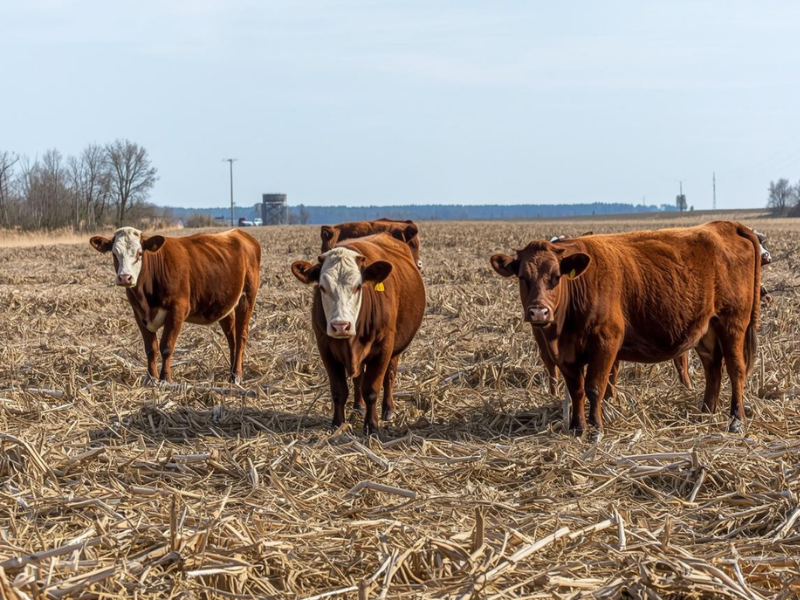
CIBO has also improved how grazing is modeled on cropland. This update better accounts for:
- Biomass removal from grazing
- Redistribution of residues
- Manure inputs and nutrient cycling
This is a meaningful step forward for systems that integrate crops and livestock. Explains CIBO’s Margaret Kosmala, Principal Data Scientist, “Grazing changes how carbon moves through a system, both in terms of what leaves the field and what returns to the soil. Capturing that correctly is essential to improving soil carbon estimates and reflecting real management outcomes.”
What these new capabilities unlock
With this latest upgrade, CIBO can now confidently support both row crop and integrated crop-livestock regenerative systems. We can expand the types of programs we support to include carbon credit programs tied to validated soil carbon outcomes, regenerative agriculture programs with diverse rotations, beef and livestock-linked sustainability programs, soil health and SOC-focused initiatives, and programs in canola-growing regions that were previously limited.
CIBO can now support a broader range of practices and rotations, and more precisely capture what farmers are already doing in the field. Programs will see more eligible acres, stronger regional coverage, higher grower participation, and, ultimately, more value generated per acre.
Built on validated science
CIBO’s capabilities are powered by our proprietary SALUS model, a process-based biogeochemical model used to quantify soil carbon and greenhouse gas outcomes. In addition to prior approval by Verra, SALUS was recently approved by the Climate Action Reserve (CAR) following rigorous third-party validation and calibration.
CAR requires that models demonstrate they can accurately quantify emissions reductions and soil organic carbon before they can be used in Soil Enrichment Protocol projects. That level of scrutiny is essential to satisfy buyer and regulator demands.
This approval confirms that CIBO’s outcomes are grounded in validated, science-based modeling, not assumptions. Companies can be confident that results not only meet registry requirements, but are backed by independent scientific review. Companies will also be eligible to issue carbon credits through CAR-aligned programs.
CIBO’s current models are now in the third round of model validation with both Verra and CAR, as we continue to refine and strengthen how our models are applied across real-world systems. With each validation cycle, we build on what’s been learned in the field. Independent review is necessary but, ultimately, execution is what determines whether a program delivers real, trusted outcomes.
The bottom line
By expanding modeling capabilities to include more cash and cover crops, and grazed cropland, CIBO can better reflect real farming systems while still offering lower-cost, scalable implementation.
Reach out to learn more.