NEWS
Driving Resilience with Data
March 10, 2026
Get the latest from CIBO. Stay connected with news, expert insights and exclusive event invitations.
SubscribeWhy Science, AI, and Data are Required to Scale Sustainable Agriculture
The data are unmistakably clear. Sustainable agriculture has become an economic imperative. More than half of global GDP depends on nature, and ecosystem disruptions like extreme weather, water scarcity, and land-use change could drive $12.5 trillion in losses by 2050.
Agriculture is especially exposed. Since 2000, nearly 70% of U.S. crop insurance losses have been weather driven. Over a third of global agricultural soils worldwide are degraded. Globally, extreme weather has halved branded food earnings and cost hundreds of billions in value chain losses. Under a business-as-usual emissions trajectory, staple crop yields could fall ~24% by 2100, driving food price volatility and cascading supply chain risk.
The stakes are high. Many leaders now view investment in sustainable, resilient supply chains as essential to long-term profitability and continuity. Yet, execution lags. Despite their sustainability commitments, only about one-third of agri-food companies have set measurable targets and fewer than 10% have committed capital to scale solutions. Many lack the data and financial tracking needed to prove outcomes or ROI, and the current measurement infrastructure won’t get them there.
Outdated systems and fragmented solutions are holding companies back
Many of today’s sustainability measurement systems were designed to confirm that a practice change occurred and to quantify environmental impact. They rely heavily on manual processes, fragmented public datasets and farmer-reported information.
Moreover, the industry is replete with disparate solutions, but lacks a single provider that has the data, technology and on-the-ground support to help scale regenerative agriculture. Many in this space also struggle to deliver the financial and environmental insights and lack the necessary infrastructure to execute against what’s promised.
Companies needs comprehensive solutions that can answer the strategic questions necessary to justify capital deployment, such as:
- What practice change will deliver the greatest soil health impact and/or yield based on local context?
- Where should capital be deployed next?
- What is the risk-adjusted ROI?
- How does resilience evolve over time?
- How does this affect insurance, financing or compliance strategy?
- How does this impact enterprise value?
To truly scale sustainable agriculture, we need a clearer picture of its risk, performance and financial return at enterprise scale. We need a framework built on science, data and AI.
With science, data and AI, we can prove ROI
With advances in AI, computer vision and biogeochemical modeling, we can transform how agricultural sustainability is measured and managed. We can drive better decisions to unlock smarter agronomy, greater productivity, and improved profitability from farm to fork.
By streamlining data capture, verification and analysis, we can move beyond manual reporting to generate trusted, timely insight into the true ROI of sustainable practices. We can unlock new revenue streams for farmers, and more predictive guidance on what practices to change, where and when.
As a result, farmers will be able to make smarter decisions that drive higher yields and margins, and long-term resilience. Companies can set and meet compliance goals, and more cost-effectively deploy sustainable agricultural practices that build resilience. Insurers and financial firms can access the robust datasets needed to introduce products that account for the risk realities of regenerative agriculture. And governments and nonprofits can streamline and deploy public incentive programs that accelerate transition while reducing systemic risk.
But AI alone won’t make this possible.
As AI models become increasingly commoditized, success at scale will come from the depth, integrity and exclusivity of the data that models are built on, and the value‑add platform that sits on top. That’s where CIBO comes in.
An infrastructure grounded in proprietary data
At CIBO, we have the infrastructure to help scale sustainable agriculture—the foundation of which is our data.
Our independent agricultural technology platform is powered by proprietary datasets, created through advanced computer vision and AI models trained on years of field-level data. These systems reduce bias by standardizing data capture and interpretation across millions of acres, minimizing reliance on subjective self-reporting.
Certified by Verra, CIBO’s foundational SALUS model incorporates peer-reviewed science and decades of academic research in crop growth, soil health, and emissions modeling. As new data are observed, our models are continuously validated, retrained and refined to ensure accuracy improves over time.
This scientific foundation allows us to generate deep historical datasets and simulate forward-looking climate, yield and financial risk scenarios, without bias. We can assess how fields perform under new practice adoption and anticipate how natural systems will behave under changing environmental conditions.
Most importantly, we can provide audit-ready, actionable intelligence to drive better decisions and deliver better outcomes for sustainable agriculture. And we remain wholly independent, without competing objectives that could compromise the integrity of our insights.
From data to action
When the right infrastructure is in place, sustainability becomes scalable.
CIBO has enabled USDA EQIP application submissions on 800K U.S. acres totaling approximately $300 million in FY2025 alone. We’ve partnered with industry leaders like Nutrien, Primient and others with major sustainability commitments on hundreds of thousands of acres. These companies rely on CIBO to provide clear, actionable insight into what’s working and to measure the impact and ROI of their regenerative agriculture programs.
On the evolving biofuel front, CIBO is able to establish credible, verifiable agricultural data at scale. This ensures ethanol producers and their partners can unlock the full value of emerging clean fuel programs. We’re also creating the historical datasets that ag insurers and financers need to better manage risk as farmers transition from conventional practices.
Looking ahead, we will continue to build upon our competitive advantage in agriculture and sustainability, leveraging our proprietary datasets to build scalable, interoperable systems that turn signals into trusted, decision‑ready intelligence. In a world where anyone can access generic models, our value will come from owning the data, understanding it better than anyone else, and continuously innovating the products, services, and experiences it supports. The data platform will connect farmers, enterprises, agronomic partners, and capital providers in a coordinated system that turns recommendations into measurable outcomes at scale. From data to action.
We can’t afford to wait
Companies who remain on the sidelines risk more than reputation and will certainly feel the pains of supply chain disruptions and margin loss. Conversely, companies that are proactive, who invest in agricultural supply chain resilience, will reap the long-term benefits of soil health and restoration. In an increasingly volatile climate environment, resilience is quickly becoming a core driver of enterprise value.
Data-driven agricultural programs have the power to stabilize supply chains, reduce exposure to climate volatility, lower compliance risk, and improve procurement predictability. For farmers, they can ensure they get the required support to be more productive and profitable. They can build in greater yield predictability, more secure supply sheds and margin stability. We can reduce our reliance on agricultural subsidies and secure the food supply.
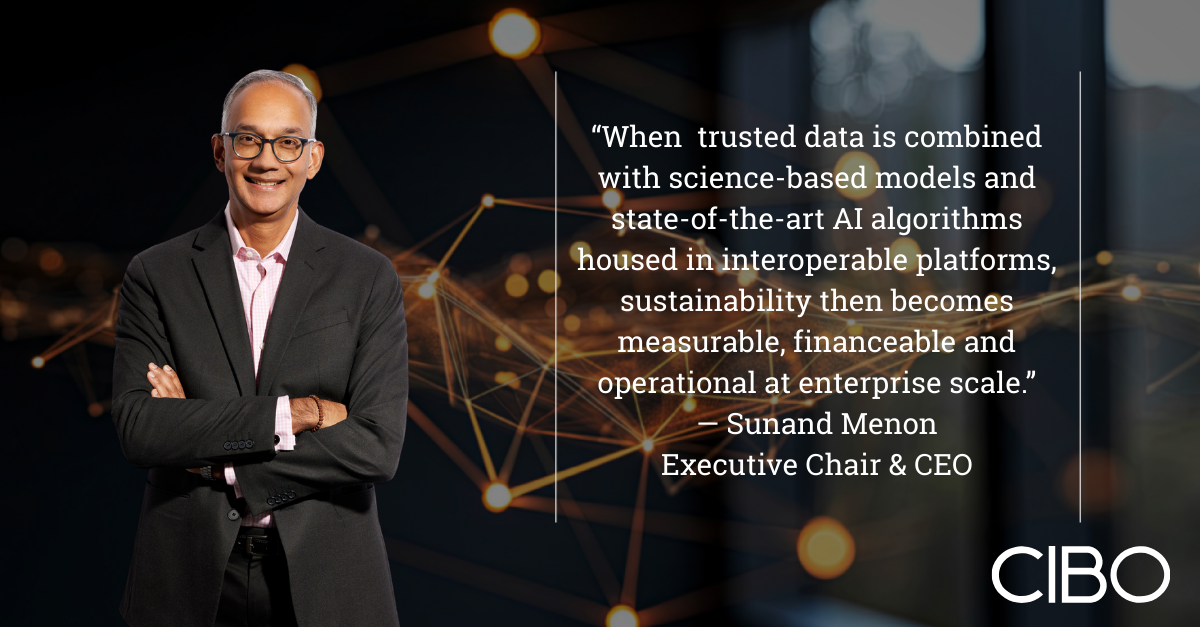
Ultimately, it all starts with scalable access to accurate, reliable and independent data. When this trusted data is combined with science-based models and state-of-the-art AI algorithms housed in interoperable platforms, sustainability then becomes measurable, financeable and operational at enterprise scale.
Author
For over 25 years, Sunand Menon has created and transformed digital, analytics and AI-enabled businesses. He is Executive Chairman and CEO of CIBO Technologies, a company created by Flagship Pioneering, where he also serves as an Operating Partner. Sunand previously served as Founder and President of New Media Insight where he helped companies create and grow new digital businesses. His career includes leadership roles at Thomson Reuters, PTC, RANE and Iron Mountain, where he launched and scaled new digital ventures and SaaS products in various domains. Sunand is also an Executive Fellow and member of the Leadership Initiative at the Harvard Business School, where he co-teaches a course on "Leading in the Digital Era" and conducts research on digital transformation and leadership. He is widely published including Harvard Business Review and MIT Sloan Management Review articles on digital strategy, data/analytics commercialization, innovation and digital leadership. He holds an M.Sc and B.Sc in Chemical Engineering from Delft University of Technology and his MBA from the Harvard Business School.